We are all used to the familiar. But it’s the unfamiliar that needs to be explored to be understood, to find where it sits in our taste profile.
At a recent family lunch the Champagne was previously served was now used to was no longer on the wine list. The replacement Lallier R20. Not a moment of disappointment rather an opportunity to discover something new. How would it meet our taste expectations?
Four values are purity, depth, intensity and freshness define their style. The estate was founded in 1906 by René Lallier by an environmentalist passionate for the Aÿ terroir. He had a sincere respect for nature and an unwavering curiosity for what each year is reflected in the grapes they produce.
Their style is a marriage of the old techniques with creative innovation. To be comfortable with this their home is in two regions Aÿ the first the sactuary of their aging cellar. The second Oger, Côte des Blancs, where they focus on contemporary production facilities. The two each different yet each essential to a marriage of the old techniques with creative innovation.
Having discovered their values, it’s time to taste how they contribute to the Champagne in my glass.
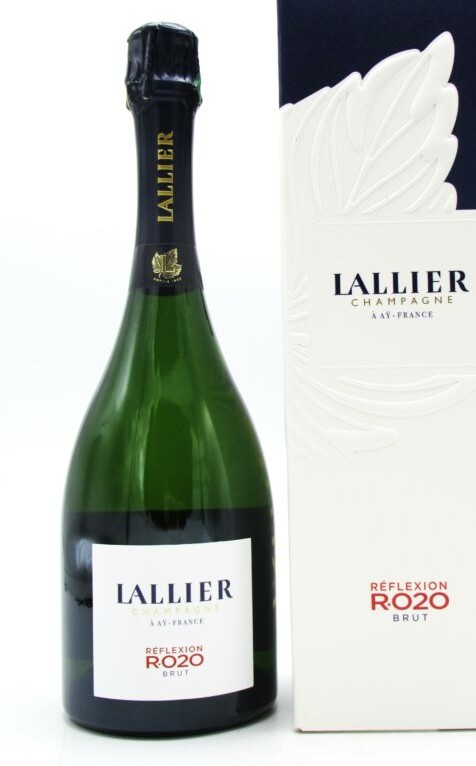
Laliller R20 from their Réflexion Champagne collection bringing a fresh perspective to Champagne. The first house to be Italian owned having been bought by Campari . A multi-vintage brut presented in a modern elegant bottle echoing the house commitment to nature freshness purity depth and intensity. 81% of the grapes come from the 2020 harvest. This is the firm time that Chardonnay dominates with 51% of the blend, 49% Pinot Noir. They are complemented with 19% of reserve wines from 2018 and 2019. The result gives intense floral and fruity aromas with delicate notes of mineral salinity.
The grapes were sourced from over 50 crus within Côte des Blancs, Côte de Sézanne and Montgueux for the Chardonnay, and Vallée de la Marne, Montagne de Reims and Côte des Bar for the Pinot Noir. They enjoyed an early harvest, starting in late August, yielding a superb quality of grapes, combining delivering intensity and freshness. The resulting base wine is strong, elegant and persistent, with a high maturity.
 A discovery journey with Laurence Civil of his best tasting experiences
Leave a comment